In this four-part series, we’ll walk you through the key steps of effective supplier management—from evaluation and setup to payment and ongoing monitoring. In this second part, we’ll focus on ongoing checks and how organizations can improve their understanding of suppliers without having to allocate additional resources. Most organizations conduct some form of…
-
-
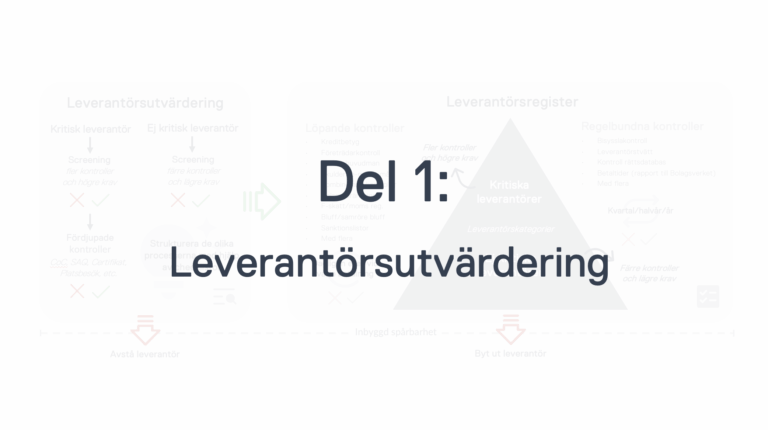
In this four-part series of articles, we will go through the main steps in effective supplier management – from evaluation and planning to payment and ongoing follow-up. In the first part, we will take a closer look at supplier evaluation and how businesses can ensure that they select the best suppliers in a time-efficient manner and ensure that...
-
Fraud has long been a challenge for businesses and public sector organizations. In 2019, we wrote about the most common types of fraud, and even then it was clear that the number of cases was increasing and that in many cases they were becoming more sophisticated. It has probably not escaped anyone's attention that technological developments since 2019 have been rapid, and we are...
-
New regulations based on existing frameworks It has probably not escaped anyone's attention that the EU has a clear agenda in the area of sustainability. Several new regulations have been introduced in recent years, and more are on the way. But how do these regulations fit together, and which requirements are already covered by existing frameworks and guidelines? Put simply, one can...
-
Back in 2019, we wrote an article about double payments and double invoicing, where we explained the difference between them and why they are so often missed by financial systems, even though most of them have built-in controls. So what has happened since then? The answer to that question is: not much. Double payments and double invoicing continue to be...
-
What is a payment file? A payment file is a digital file, usually in XML or TXT format, that contains structured information about one or more payments that a company or organization wants to make. The file is exported from the business's financial system and then sent to the bank and/or bank giro for execution. The exact content may vary, but a payment file...
-
It may not be immediately apparent, but Sweden is in the midst of an extensive modernization of its payment infrastructure. At the heart of this is the transition to ISO 20022, a global standard for financial messages that replaces older formats such as SWIFT MT and Bankgirot's LB, KI, and BgMax files. In this article, we provide an update on the rollout...
-
On March 1, 2022, a law on reporting payment terms came into effect. This means that Swedish legal entities with more than 249 employees must report annually to the Swedish Companies Registration Office on their payment terms for purchases from companies that are smaller than themselves. The information will be public and available to the general public. The purpose of...
-
Using factoring companies is common practice today, and factoring offers many advantages. Even larger organizations have begun to use the various services offered by factoring companies, and the future looks bright for the factoring industry. However, there is a risk of an unpleasant surprise. Sharing a bank account number with several other organizations can have negative consequences that few people are aware of...
-
Manual steps in the payment process always pose a risk Any activity that requires manual work to complete a task poses a security risk. A common example of a security breach is when a supplier payment is initiated. First, standardized payment files are created in the business system. The payment files are exported to a directory on the server or network and then often...