
Supplier evaluation – choose the right supplier and avoid unreliable operators
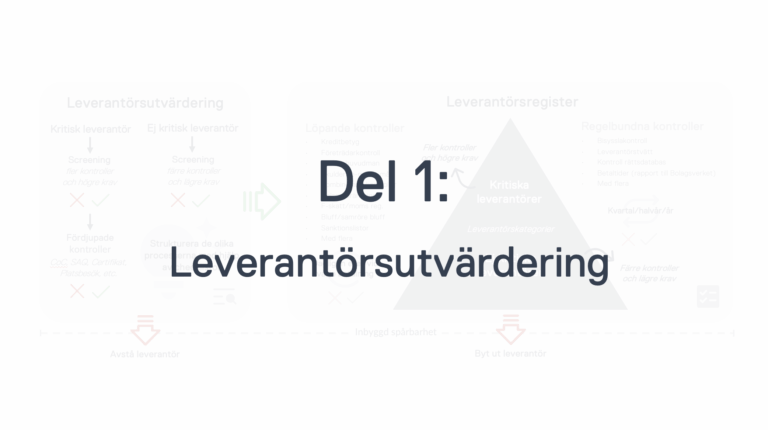
In this four-part series of articles, we will go through the main steps in effective supplier management – from evaluation and planning to payment and ongoing follow-up. In the first part, we will take a closer look at supplier evaluation and how businesses can ensure that they select the best suppliers in a time-efficient manner and avoid doing business with unreliable operators.
Choosing the right suppliers is one of the most critical parts of an organization's purchasing and risk management process. An incorrect assessment can lead to financial losses, poor delivery reliability, quality problems, and legal risks. Therefore, a structured and risk-based supplier evaluation is one of the most effective ways to create security in the business's commercial relationships. The first step in such a process is a quick and effective screening. Depending on the type of supplier, there may then be a need for more in-depth checks after the screening.
Fast and effective screening – the first filter against unscrupulous operators
Screening is the initial and fundamental step that should be taken for all suppliers. It may seem unnecessary to check suppliers for the smallest one-off purchases, but the fact is that errors made by these suppliers can be costly for your business. For example, if they do not have F-tax registration, there is a risk that you will pay too much when purchasing services, and you may also be liable to pay social security contributions on the purchases in the event of a tax audit. Always checking that the company is registered for F-tax, regardless of what is stated on the invoice, is a good way to protect yourself against this. Many unscrupulous operators also take advantage of organizations' lack of controls on small purchases. Failure to check these suppliers and transactions exposes your organization to a high risk of paying incorrect invoices to unscrupulous or outright criminal operators.
In many cases, implementing comprehensive screening may be sufficient to proceed and register a supplier. With good system support, such as Betalkontroll, you can automatically perform the checks needed to ensure that a supplier is "clean and above board." The OECD's guidelines for due diligence point to the importance of having a risk-based methodology. This means that businesses systematically select the parts of the supply chain that pose the greatest risk. The aim is to be able to concentrate the business's resources on these specific risks.
Needs-based evaluation – in-depth checks where they are useful
Depending on the type of purchase and supplier, comprehensive screening may be sufficient to set up a supplier. In many cases, however, more in-depth checks are needed. Many of these checks can be performed in systems such as Betalkontroll, but some of the checks require other tools and resources. Below are examples of what determines the types of in-depth checks that may be relevant for a specific supplier evaluation:
- The size of the purchase and whether it involves a recurring supplier or a one-time purchase
- The complexity of the product or service
- The supplier's strategic importance to the business
- Risk factors: The supplier's industry and country, previous experience with the supplier, etc.
- Insights from initial screening → follow-up on any risks that have emerged
All of the above points can determine the scope of the in-depth checks you choose to perform, but also which checks are necessary. For example, public cases the screening shows that the company has a debt balance for public cases it may be appropriate to obtain a full credit report and also ask the company about these debts. Below are examples of in-depth checks that may be relevant depending on the specific case:
- Full credit reports (in Betalkontroll)
- Ownership structure and changes in ownership (in Payment Control)
- Check against Swedish legal database (in Betalkontroll)
- Code of Conduct for Suppliers (in Betalkontroll)
- Control of necessary processes, documentation, and certifications (in Payment Control)
- Site visit to the supplier
- Reference checks and searches for negative media coverage
- Questionnaire related to sustainability and delivery capacity
- Follow-up on any risks identified in the screening
Summary
Supplier evaluation is much more than an administrative task—it is one of the most important protective mechanismsfor avoiding unscrupulous operators, ensuring quality, and creating long-term sustainable business relationships. By combining:
- fast and effective screening,
- risk-based assessment,
- in-depth checks and
- a structured process with continuous monitoring
your organization can make better decisions, reduce risks, and build a supplier network that actually strengthens your business.
Also, keep an eye out for upcoming articles in our series on effective supplier management:
Part 2: Ongoing supplierchecks – identify risks and work proactively with suppliers
Part 3: Regular checks, analyses, and reports – ensure compliance and identify costly errors
Part 4: Internal processes – built-in traceability and enhanced supplier knowledge